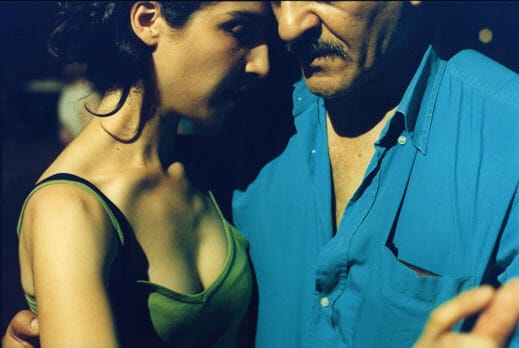
It’s true that tango is macho. Professional contemporary dancer and dance scholar Elly Brickhill who came to tango after 35 years of modern and social dancing, said that she had never seen an Australian man treat a woman the way that tango students in classes routinely do. She noted “no Australian man would speak to his wife or a co-worker in that way”. Studying the dynamic, Elly concluded that the visiting male Argentine teachers gave Australian men permission and modelling for macho behaviour: Men know what’s going on and women should remain silent. Even when the woman is more experienced than their partner, even when the movement is causing her pain, or even when the woman has understood the teacher’s instructions and the man has not.
The tango macho license for arrogance is not only for men. A number of times my male private lesson students have reported to me that when they tried dancing with a more gentle embrace, women abused them by saying things like “hold me like a man”. These women were obviously accustomed to a beginner leader’s rigidity and force. Without it they didn’t feel confident in what to do. They had not yet been told or noticed that advanced dancers have almost no tension in the embrace, because more advanced moves require a more flexible embrace. They had not yet learned or observed that with more experience, they need less tension to perceive the mark. Yet they felt entitled to abuse their partners while dancing. In doing so, they retarded both dancers’ development.
In 15 years of dancing to date, I remember clearly that –save one very carefully crafted situation– every time that I gave feedback to a male leading dancer who was not my student, he never danced with me again.
• • •
Arrogance is a symptom of tango, but it’s not the only reason to shut the fuck up.
Tango renders all of us vulnerable, too vulnerable to withstand criticism.
Unlike work, social, and sportive activities, tango requires that we show up with every aspect of ourselves: not only our physical skills, but also our intellectual ones. It requires that we work our muscles, improvise intelligently, manifest our coolest masculinity and femininity, override insecurities and anxieties, and keep our minds absolutely focused like meditation – all while both enjoying and managing intense emotional and sensual experiences.
Generally, resilience to rejection and criticism depends on our ability to withdraw or ascend to other dimensions of our identity with reserves of confidence and perspective. When we are dancing tango, there is on “other dimension”. We’re using every aspect of ourselves. And there are no reserves. We’ve spent everything on the confidence and focus it takes to walk in this door and onto that floor. Deep into this quest with everything we have, the codigos are our only protection.
When we have no aspect of ourselves to retreat to, we are like a raw wound. Criticism is intolerably painful and effectively annihilating. That is why we need an etiquette that protects everyone’s egos all night.
Three times in my years of dancing I have been criticized by people who were not my teachers. Even though these comments happened off the dance floor, and two were oblique and indirect, they continue to induce pain and doubt.
• • •
A new student came to me to work on memory and improvisation. As part of programming preparation of his memory before each dance, I wanted to replicate the milonga rituals. So before each song, we sat down and waited for the music. Then I wanted him to cabeceo me. “I’m not doing that macho shit!” he said, thrusting his hand at me.
I decided not to derail the lesson with a sidebar on the diverse and unforeseeable benefits of proper etiquette. This turned out to be a mistake.
After our class he went to a milonga. I wrote to ask him if his memory program worked. It did, but there was another problem related to some technique corrections I had made. He told me that the first friend he danced with insulted him during the dance. She said “what are you doing?” and “this isn’t working.” He was devastated. It destroyed his confidence and surely his skills crumbled shortly thereafter.
We need the etiquette. Even (or especially) among friends and frequent dance partners.
She should have been limited by the silence of the dance. She would have had to use her body to try to discover and respond to what he was marking. Had she disciplined herself to the etiquette of silence and finishing the tanda politely, after a couple of songs she would have figured it out, and had some new experiences.
While the cabeceo and the codigos are not macho, there is macho in tango. The macho is the arrogance and disregard for others. It is a toxic part of tango. And it’s not limited to men. Why does this woman think she is right? Why does she bring arrogance and insults instead of humility and curiosity?
Tango is a big dance. Most of us have a lot to learn. If you feel something strange, it is probably your lack of knowledge, not your partner’s error.
I’m a lot more expert and strong than this student, but I can also be annihilated by a few words about my dancing. Two of the people who obliquely insulted me are among my favorite dance partners, and judging by the time they spent dancing with me I was also a rare find for them. But in one moment of carelessness those relationships are forever changed. I do not approach them with the joy and trust that I did before. Because I bring less power, we get less from our dances.
Dancers cannot afford to abandon the etiquette. It’s dangerous to our friends, to our development, to our communities, and to our art.
• • •
My book, Until Forever, has the subtitle “the dark silences of Argentine Tango”. It also catalogues the sublime silences. Tango’s silence allows us to experiment, to grieve, to fail, to reach for the unknown in ourselves and others. We move in all these dimensions, embraced and accompanied, in a gracious silence.
Around 2011 in Buenos Aires there was a new local couple (now very famous) dancing every night in the milongas. They danced for hours, eyes lowered. Between songs and tandas they stayed silent in the embrace. No break in concentration, no emotional distance, no chit-chat. I never saw them change partners and I never saw them speak.
Their model has become my preferred way of training, and dancing, silent in the milonga. We agree beforehand that we’ll dance an hour. This removes all the uncertainty at the cortinas: Does he like it? Am I doing ok? And nothing can be “fixed”. Blame is not an available solution. We can only each go deeper and deeper into our own responsibility and into the partnership as it is. We find solutions in our bodies and capacity, in the communicative technology tango gives us. We discover riches beyond what we knew.
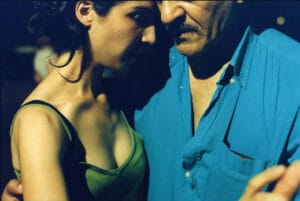
photo by Romain Baillon
Blog posts about
the codigos, cabeceo,
emotions, and etiquette



No means no

Pleasures of the Cabeceo

Hugs and Laughter
The Perfect Tanguera
How to be a Good Man, as you become an Advanced Tanguero
How to become a Hot TangoMan

The codigos (advanced)

Code of Ethics for Tango Communities

Why I don’t ask Marks to dance…
Emotions on the dance floor
The reverse cabeceo

Rethinking cortinas

The power of desire

How do I ask someone to dance? (the cabeceo)