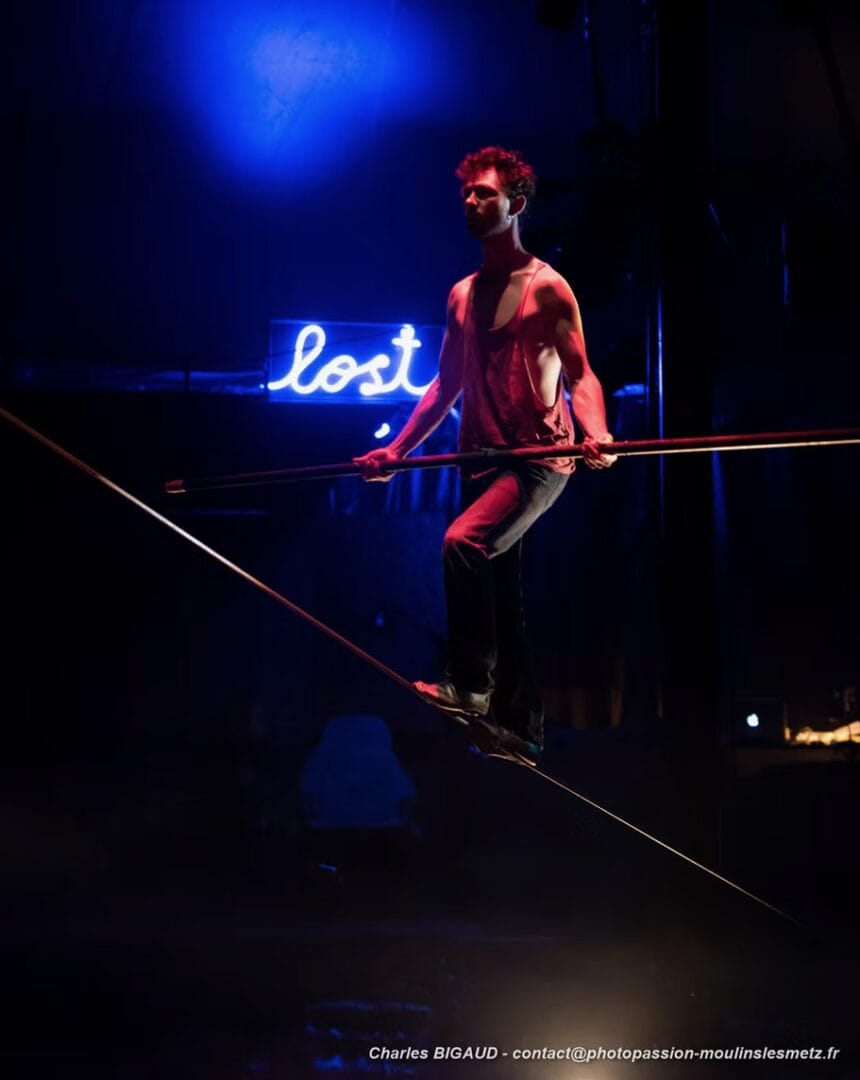
You know I love circus. Here in the countryside of Southern France, we get great circus. A nearby farm devotes a field to circus residencies. An assortment of caravans arrive to make the first circle. Then a semi-truck delivers the tent. Finally the weekend comes. A few strings of lightbulbs make the field a festive destination and hundreds of neighbors enter this precious circle to drink beer and wait for the doors to open. This is a very old ritual.
Inside this tent a tradition lives. An art form utterly dependent on things becoming rare: interdependence and trust, full presence, and daring. This tradition continues to depend on an amalgam of glamour and hardship that is simultaneously familiar and unimaginable – and the decision of people to endure it in order to live their art.
The Cirque Pardi spent a year and a half writing their show “Low Cost Paradise” in 2020 and have performed it 260 times in 3 languages. If I understand correctly, the show I saw was the last episode. When they took their bows, the artists were crying.
After closing the show, they use their residency to start work on a new show. The troupe has a commitment to spend half of each year touring together, going their own ways for independent projects for the rest of the year.
Low-Cost Paradise is described as an “homage to fragility”. One of the performers told me that the troupe wrote the show together, “following our intuitions”. In a range of moods from poignancy to cacophony, violence to joy, the show explores the absurd habits and emotions of daily life, constantly wondering what to do with this paradise? The flying trapeze artist ends her performance asking “is that all? there’s only dust.” The musicians allow us to hear the artists talking to themselves as they perform. The tightrope walker strings his rope going uphill. Instead of delivering a clean, precise walk, he uses his skill to show us yearning, failing, vulnerability. The contortionist bends over backward to express the pain of romantic abandonment. The juggler stumbles over the edge of the stage. The obligatory sparkling girl on the fixed trapeze finishes her routine by dropping unglamorously three meters to her safety mat – showing us what it would mean to fall. The show ends with another spectacular drop from the top of the tent which could be understood as a suicide, or just the suddenness of endings. They sing “we were only taught to survive.”
My love for circus is a highway to my sadness for tango’s undoings: its deterioration and its lack of doings – what we are not doing. While Argentine Tango yearns to be classified as “art”. Dancers who express something beyond the template of elegance us are marginalized and degraded, told that what we are doing is “not tango”.
Every art form is torn between tradition and relevance. And indeed tango’s efforts to develop (whether toward modernization or retrenchment) are decried as “not tango” by every decade’s dancers.
I claw at my fading perceptions of Cirque Pardi for new insights about the correct role of tradition in one’s art.
One force in the direction of innovation is the character of those who choose circus – these are people who will not be contained.
Yet relatively little of what they do is new.
It’s the circus tradition which offers a recognizable and functional institution: A livelihood and identity which allows them to live on their wild edges by delighting people. A professional community whose high standards of commitment and conduct is essential to their professional and personal well-being. An audience who recognizes everything once the tent goes up.
Artistic formalisms of light and laughter to distract the audience from tricks and costume changes and tedious security rigging. A rhythm of thrill and poignancy. Extreme skill and control, practiced until it is bone.
They use tradition. They don’t conform to it.
They dress it down. They fill it with emotion. They tilt the high wire. They stumble. The diva falls from the trapeze. The clown speaks.
They thrill us with acrobacy so we are rapt for the delivery of poetry.
The lights rest bright on the empty trapeze. Reminding us that what brings it to life is courage.