videos: Jean-Pierre Van Loocke
Friday: Elasticity, Sacadas
1: Elasticity
Elasticity is a dynamic which modifies a tango movement.
Elasticity applied to a step creates a rebote. We do a lot of these, so let’s make them delicious.
The biomechanics of elasticity is co-contraction (simultaneous contraction of paired muscles).
To create a rebote, during the transfer of weight of a step the Mark co-contacts quadriceps and hamstrings of either the receiving leg or the sending leg of the step. (We prefer to apply co-contraction to the sending leg on front and side steps.) The Revel/Follower copies and her movement should be delayed (consequential).
To make the elasticity whole-body we allow the shoulders to flex/extend and then co-contract triceps/biceps pair.
In contra rebotes, the Mark does not need to grip the Revel. She will feel and copy the co-contraction.
(Why we prefer ‘Mark and Revel’ to ‘leader and follower’.)
2: 48 Sacadas
Part 1: The sacada game.
- No embrace, no Mark.
- One person opens and the other enters.
- The partners’ steps must be perpendicular, with the receiver’s step perpendicular to the line between the partners’ spines.
- The entering step must be placed next to the receiver’s sending leg.
- Collaborate in waiting during projection and then transferring at the same time.
- Both partners are free to change feet and pivot to explore the possibilities.
Part 2: Learn how to find all the variations.
- There are 48 sacadas, 24 in which the Mark enters the Revel’s step and the other 24 in which the Revel enters the Mark’s step.
- There are 6 ways to receive (front side back lateral steps with each foot and 4 ways to enter each step (2 front steps and 2 back steps).
Part 3: How to lead:
- For a Mark’s sacada, communicate a lateral direction (right or left of the Mark). It’s important that the Mark can communicate without moving their own feet and that the Revel projects without transferring any weight to the receiving leg.
- For a Revel’s sacada, the direction of communication is always toward the Mark. The Revel must fortify her base leg in relation to that force so that she can project without transferring her weight. The leader then steps laterally, allowing the shoulders to flex laterally. (Lateral shoulder flexion is the embrace specification for all contra movements – movements in which the partners go in different directions.)
Saturday: Technique for Balance, Connection, Precise Marking and Spacious Revelling
3: Biomechanics of Balance and Connection
Position of the bones for balance on one leg: front of the base leg’s rib cage should be positioned over the knuckle of its big toe. Hip bones must be behind the rib cage. This position creates an arc in each dancer’s body.
Muscles for stabilization: Piriformis muscle stabilizes the relation between the femur (bone of the upper leg and the spine. Peroneal muscles can be activated by starting to rise up on your toes, and these trigger a chain of stabilizing muscles, including the transverse abdominus which stabilizes the spine.
to build the Arch of Connection, aim the two arcs at one another. re-aim at the end of each step. (For sublime connection, the arc is adjusted throughout the transfer of weight as well, so there is never a moment of disconnection. )
We practiced first in close embrace
In open embrace, we need to build the arch through the arms.
- Contract the triceps to extend the elbows. This keeps the embrace taut.
- Pay attention to the hands: The Mark’s fingers should be open, never gripping the Revel’s body. The Revel’s hands should be listening with all the fingerpads and the blades of the hands. (The Mark leads to her hands, not with his hands!)
- The shoulders must be kept in external rotation.
We used double ganchos to practice creating balance together through the arch.
4: Muscles of precise marking and spacious revelling
There are 4 directions: toward the Mark, away from the Mark, right and left lateral of the Mark.
We use 3 muscles to communicate these 4 directions.
- Away from the Mark: contract the gluts to extend the hips and push the chest forward.
- Toward the Mark: contract the psoas muscles to pull the hips backward.
- Lateral to the Mark, oblique muscles
There are 2 Specifications of the Embrace (relevant to the directions)
- Toward or away from the Mark: stabilize the shoulder joints.
- Lateral to the Mark. Slightly adduct the leading arm and destabilize completely the trailing arm.
Sunday: Opening and Closing the Embrace, Delicious Ganchos
5: Opening/closing the embrace why & how
Introduction to the TangoForge 5 Biomechanial Tools (video here). In workshop 1 we did elasticity in the shoulder joints. In workshop 4 we did stabilization and destabilization for projections. Here we look at 2 pairs of movements which are distinguished by their embrace specifications.
Walking vs. closing and opening the embrace
- for walking toward and away from the Mark, we need to stabilize the shoulder joint.
- for closing or opening the embrace, we need to destabilize the shoulder joint, so the Mark can move closer or farther without moving his hands!
Change of foot vs. lateral projection
- for projection, the leading arm abducts and the trailing arm is destabilized so that it does not move in space.
- for change of foot. both shoulder joints are stabilized, but without any abduction!
6: Delicious ganchos
Exercise: Revel looks for a gancho, ensures her body is in a good position (with rib cage over knuckle of the big toe) and then the partners find a comfortable embrace.
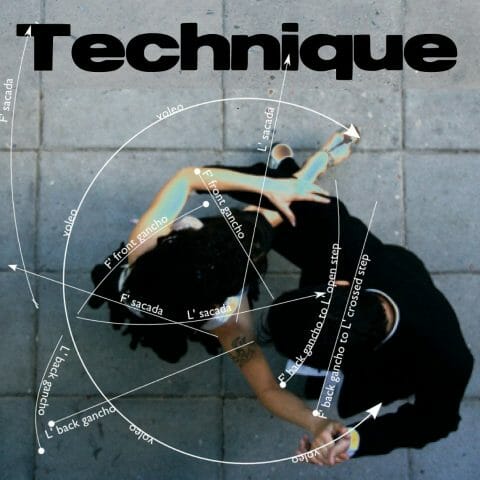
Gancho = Voleo + Intersection with partner’s body
There are many, many ganchos, and many different ways to enter. We presented two entrances:
Method 1 for marking ganchos: from parada
- start with a parada in which the follower has weight split between her feet.
- leader destabilizes shoulder joints and then walks around to get positioned for the gancho.
- leader transfers follower’s weight to one foot
- leader uses 4 directions to guide free leg into the gancho
- we did not have time to mention that in many positions it’s possible to mark through the legs with direction toward the Mark or around the body (piernazo) with direction lateral to the Mark
method 2 for leading ganchos: modified sacada
- instead of stepping to the Revel’s departing leg to create a Mark’s sacada, the Mark can step toward the her receiving leg.
- it’s necessary for the Mark to wrap their body around the Revel’s body to get the embrace close, to get the intersection point close, and also to draw her leg in to him, rather than throwing it outside, which is the result of a sacada.